
How long does it take to charge an EV? Why 22 kW isn't always faster
AC charging time depends on the car's on-board charger, not just the charger. How to estimate it, how often to charge, and why a socket is only a backup.
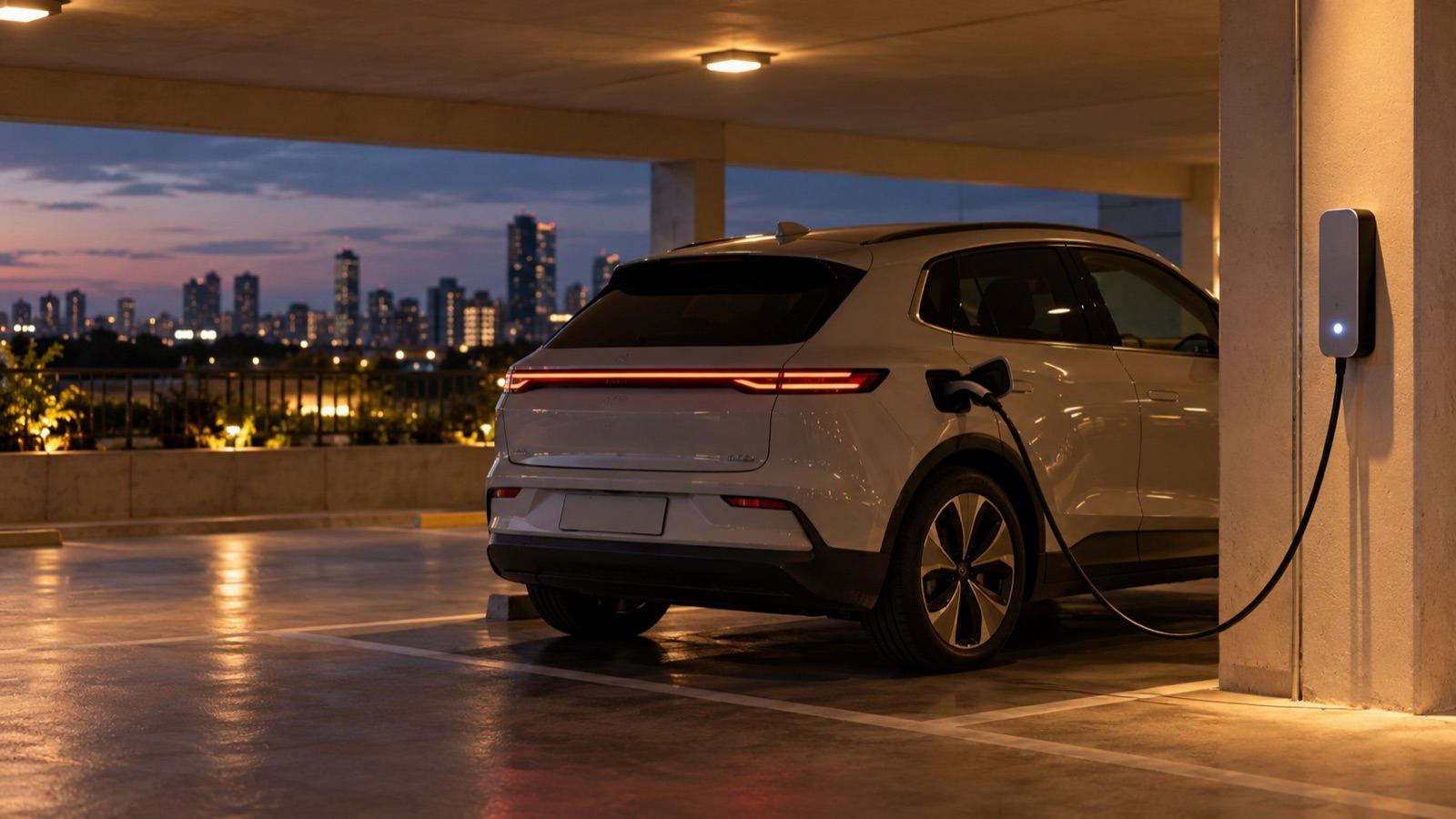
After a condo installs chargers, the questions residents ask most are "how long does it take?" and "why is my car charging slower than 22 kW?" The answer is a part inside the car.
The on-board charger sets the speed
On AC, power from the charger goes to the car's on-board charger, which converts it to DC for the battery. So the real speed is the lower of the charger's power and what the on-board charger accepts.
For example, the BYD Atto 3 and MG ZS EV have a 6.6 kW on-board charger, so they take the same time on a 7 kW or a 22 kW charger. Cars that accept 11 kW or 22 kW get the full benefit of a 22 kW charger.
A simple way to estimate charging time
Charging time (hours) ≈ energy needed (kWh) ÷ power the car accepts (kW)
For example, charging a car with a 60 kWh battery from 30% to 100% needs about 42 kWh:
| Power the car accepts | Approximate time (30% → 100%) |
|---|---|
| 6.6 kW | About 6.5 hours |
| 11 kW | About 4 hours |
| 22 kW | About 2 hours |
Real times depend on the model, year, temperature and battery condition, and cars slow down near full to protect the battery. Your car's manual lists its on-board charger power.
You don't need to fill up every time
- Most cars go about 300–500 km on a full charge.
- Most people charge in cycles, 2–3 times a week from 30% to 100%, which is enough for daily life.
- So overnight charging in a condo is enough for almost every car, even one that only accepts 6.6 kW.
A household socket is a backup
Charging from a household socket takes about 11–24 hours per charge. It's better for emergencies than everyday use, and ordinary sockets aren't designed to carry high current for hours. A bay with a wall charger means residents don't have to rely on it.
Which cars work with EVC chargers?
Type 2 chargers work with every EV brand in the Thai market, including Tesla, BYD, MG, GWM, NETA, Volvo, BMW and any brand using the Type 2 standard. For the difference between AC and DC charging, read AC vs DC charging, and for the chargers EVC installs, see EV chargers for condos.
Frequently asked questions
Do I need to charge my EV every day?
No. Most cars go about 300–500 km on a full charge, and most people find charging from 30% to 100% two or three times a week is enough for daily life.
If my car only accepts 6.6 kW, what's the point of a 22 kW charger?
A 22 kW charger delivers whatever each car can accept. Cars with an 11 kW or 22 kW on-board charger charge faster on it, so one charger suits every model now and in the future.
Can I charge from a household socket instead?
In an emergency, yes, but it takes about 11–24 hours per charge, and ordinary sockets aren't designed for high current over long periods. A parking bay with a charger means you don't have to rely on it.
Sources and standards
Newsletter
Get new articles by email
EV charging know-how for condos and buildings, every two weeks.
Related articles
AC vs DC charging: what's the difference?
Choose the right charger for your residence or building
Read more →
EV chargers for condos: PILOT AC 22kW and Schneider Charge Pro
A spec comparison of the two wall-mounted AC chargers EVC installs in condos
Read more →
Charging with the Galvanic app, step by step
Scan a QR code, start or stop charging, and pay with PromptPay or credit card
Read more →