
Safety systems at a condo EV charging station
What a safe condo EV charging station needs: a dedicated circuit, Type B residual current breakers, three levels of power cut-off, on-site fire equipment, regular maintenance and staff training.
Safety is one of the first things committees and residents ask about when a condo plans EV chargers. This article lists the protection EVC installs at every station, from the distribution board to the equipment on site, so you can use it to decide or to check any provider.
Equipment standards
- 22 kW AC chargers certified to IEC 61851-1 and IEC 62196
- All electrical equipment certified to TIS and/or IEC
- Designed and installed by electrical engineers licensed under Thai law, following the EIT standard
Four layers of electrical protection
-
Dedicated circuit
Fed from a spare way of the main distribution board (MDB) and shared with no other system, so power to the charging station can be cut on its own.
-
Type B residual current breaker per charger
Each charger has its own breaker that protects against both AC and DC leakage and overcurrent. If one charger has a fault, only that charger is cut off.
-
Independent main breaker
Cuts the whole charging station in one place, is clearly labelled, and doesn't affect the rest of the building.
-
Earthing
Installed to the standards of the Provincial and Metropolitan Electricity Authorities (PEA/MEA).
Three points to cut power immediately
| Cut-off point | What it cuts |
|---|---|
| Red emergency stop button on the charger | Stops that charger immediately; anyone can press it |
| Residual current breaker per charger | Only the charger with the fault |
| Charging station main breaker | The whole charging station, without affecting the rest of the building |
Layout around the chargers
- Evacuation routes at least 1.5 m wide and free of obstacles
- Exit signs and direction arrows visible along the whole route; fire stairs ready to use; doors not locked or blocked
- Away from flammable materials, with enough lighting
- EV symbols painted on the bays to mark them for electric cars
- Instructions and contact numbers on every charger
Safety equipment at every station
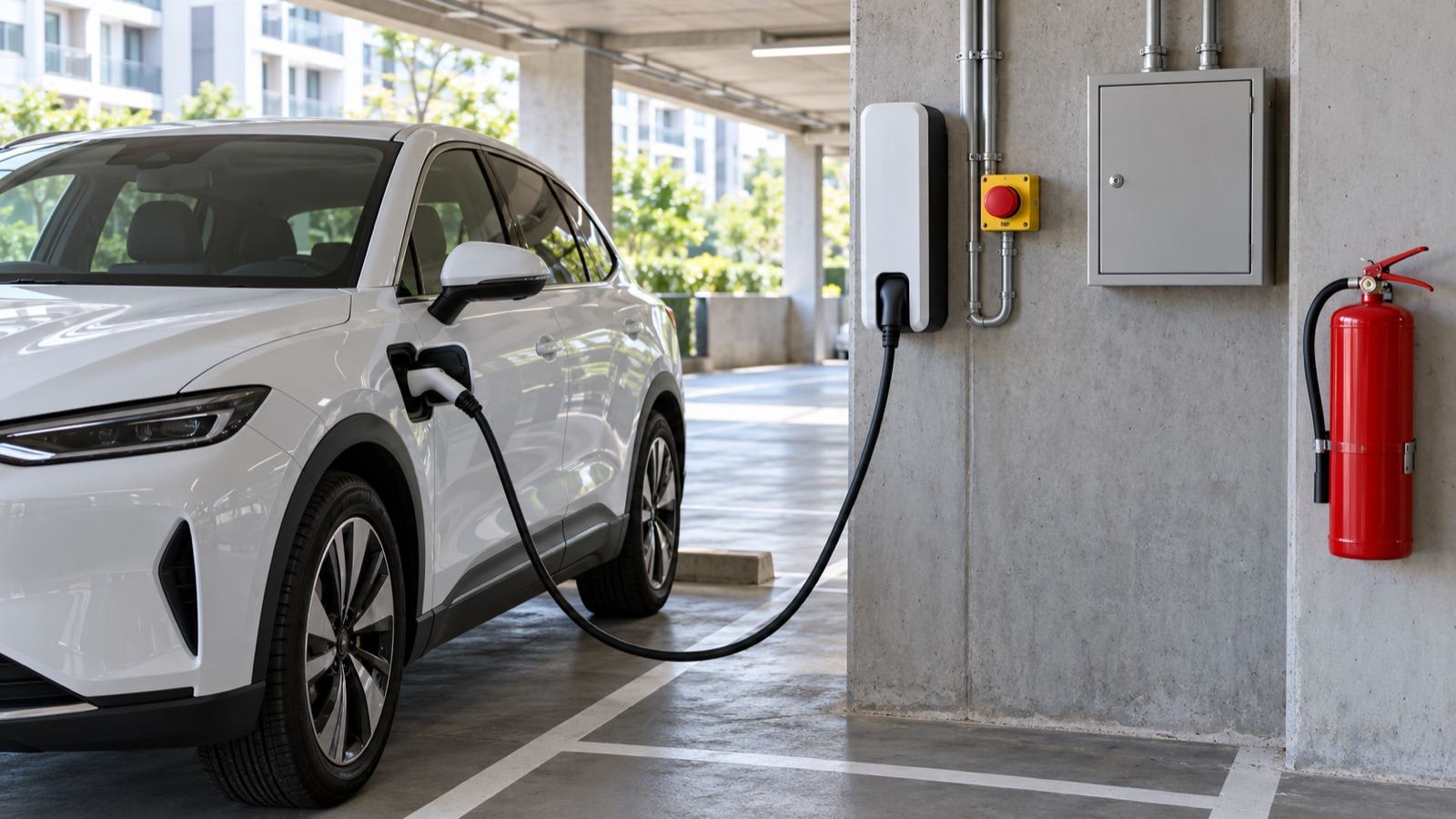
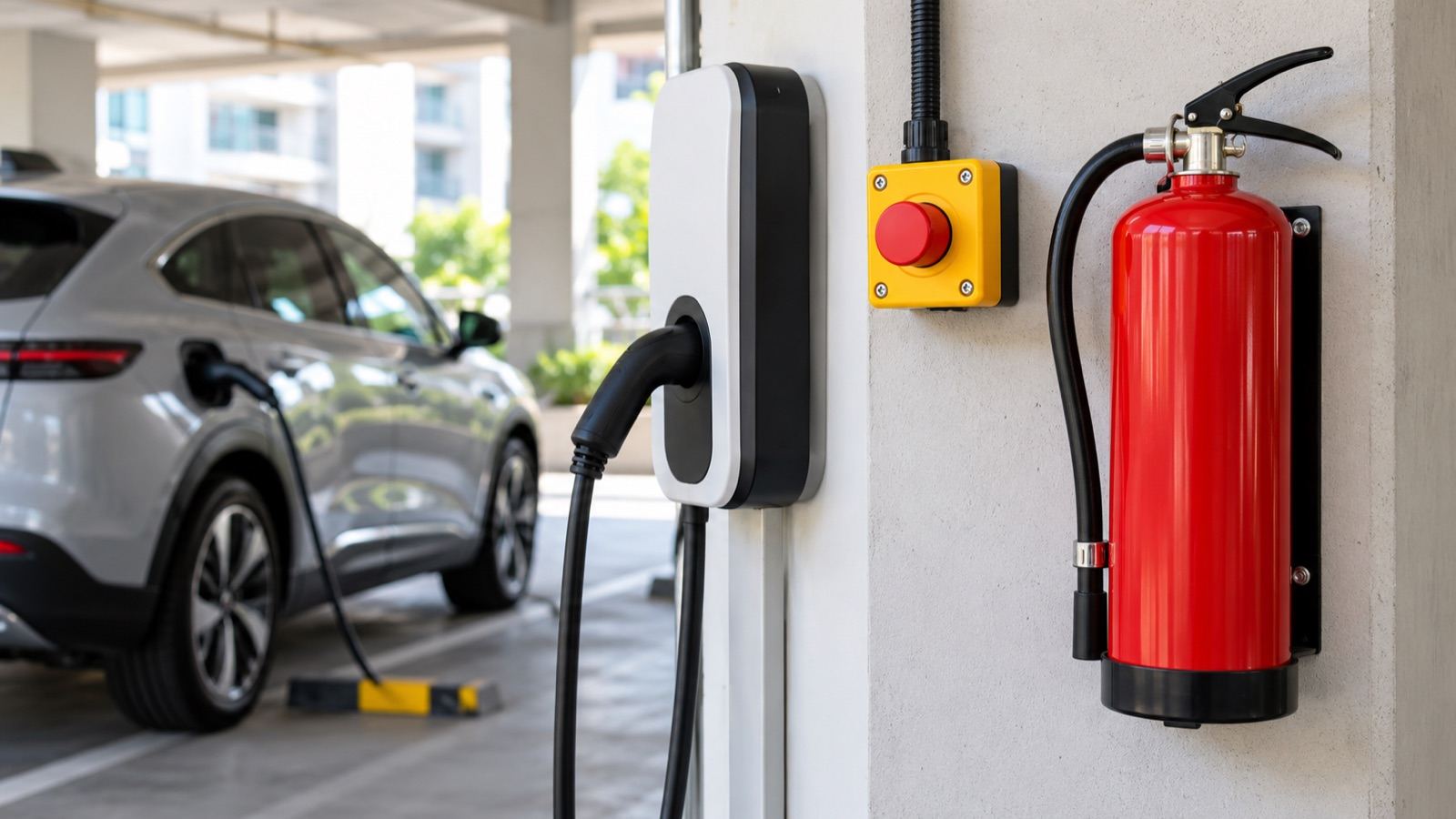
- 5 kg ABC dry chemical fire extinguisher for general and initial electrical fires
- Red emergency stop button on every charger, clearly visible and easy to press
For how to use this equipment in an incident, read what to do if there's a fire at a condo EV charging station.
Maintenance
EVC technicians inspect every 4–6 months (2–3 times a year) for the whole contract. They:
- Check the condition of the chargers, cables and connections
- Test the main breaker and emergency stop buttons
- Check earthing, the Type B residual current breakers and other breakers
- Test that the whole system works
Training building staff before launch
Before a station opens, EVC trains the building management team, technicians and security guards on using the chargers and where the emergency stop buttons are, where the breakers are and how to cut main power, how to use the fire extinguisher, and how to report an emergency.
Who is responsible for what
| Area | Responsible |
|---|---|
| Chargers, cables, control cabinet, main breaker and circuits EVC installs | EVC |
| Damage caused by a charger fault | EVC (insured) |
| The building's main electrical system and feeder cables up to the charging station | Juristic person / building |
| The car's battery, cooling system and roadworthiness | Car owner / manufacturer |
| Using the chargers correctly | Users |
For the standards that cover the chargers and plugs themselves, see what are IEC 61851 and TIS 62196.
References
Frequently asked questions
Does an EV charging station put the condo's electrical system at risk?
EVC stations run on a dedicated circuit from a spare way of the MDB, separate from the units and other circuits, with their own main breaker. Power to the charging station can be cut without affecting the rest of the building.
How often are the chargers inspected?
EVC technicians inspect every 4–6 months (2–3 times a year). They check the chargers, cables and connections, and test the main breaker, emergency stop buttons, earthing and residual current breakers.
Who is responsible if a charger fault causes damage?
The chargers, cables, control cabinet, main breaker and circuits EVC installs are EVC's responsibility. Damage caused by a charger fault is covered by EVC's insurance, subject to the policy terms.
Sources and standards
- MPESTD-001:2563 (กฟน. / กฟภ. / กกพ.) มาตรฐานการติดตั้งทางไฟฟ้าสำหรับบริภัณฑ์จ่ายไฟยานยนต์ไฟฟ้า สำหรับบ้านอยู่อาศัย อาคารชุด และอาคารสำนักงาน
- มาตรฐานการติดตั้งทางไฟฟ้าสำหรับประเทศไทย (วสท. / EIT Thai Electrical Code)
- IEC 61851-1:2017 – Electric vehicle conductive charging system, Part 1: General requirements
- IEC 62196-2:2022 – AC charging connectors (Type 2), Part 2
- มอก. 62196 เล่ม 2-2566 (TIS 62196-2, identical to IEC 62196-2:2022)
- IEC 62955:2018 – Residual direct current detecting device (RDC-DD) for Mode 3 charging
- IEC 60364-7-722:2018 – Low-voltage electrical installations: Supplies for electric vehicles
Newsletter
Get new articles by email
EV charging know-how for condos and buildings, every two weeks.
Related articles
What to do if there's a fire at a condo EV charging station
Why incidents usually involve the car's battery, and how to handle battery and electrical fires
Read more →
What are IEC 61851 and TIS 62196?
The charger and plug safety standards every condo should check before installing
Read more →
EV chargers for condos: PILOT AC 22kW and Schneider Charge Pro
A spec comparison of the two wall-mounted AC chargers EVC installs in condos
Read more →